Zoltar
If you’ve been using the Yes/No Oracle from Hands-Free RPG, but not the Zoltar Oracle, it’s time for an introduction. Zoltar Oracle might just be the more powerful tool.
What’s a Zoltar?
Zoltar was one of those machines you might find in a beach town by the pier. Put in some money, ask a question, and it gave a fortune cookie response you could interpret to mean whatever you wanted. Mostly harmless.
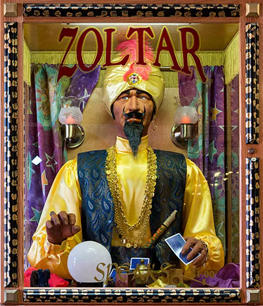
It’s also the name of the random word generator in Hands-Free RPG.
How Does the Zoltar Oracle Work?
Zoltar generates words by guiding you to take any arbitrary start word and apply a pair of rules to it. These rules transform the start word into a new word, altogether different from your start word. Any word you come up with is fair game as long as it follows the rules:
- The Fixed Letter Rule: One letter of the start word must be in the same position in the new word.
- The Floating Letter Rule: One letter of the start word must exist in the new word, but in a different position.
It then becomes a little word puzzle. Let’s say the start word was PODIATRY. If I picked a D as fixed (third position) and the O as floating (anywhere BUT the second position), this gives me a finite list of word possibilities. I could wind up at O?D → ORDER, or ??DO → INDOCHINA, or ??D????O → RADIATION. The resulting new word is generally unrelated to the arbitrary start word, giving the strong sense of randomness. More examples are in the game rules.
Interpretation
The goal is to then interpret the new word in the context of the question. If the question put forth was “What do I find in the alien cave?” I'd have to stretch my imagination to find an answer that makes sense:
- ORDER makes me think of stalactites hanging from the ceiling evenly spaced in a grid. How unusual!
- INDOCHINA makes me think of colonialism, so I find evidence of an expedition camp here, long abandoned. Were they humans? What were they looking for?
- RADIATION could be literal, evoking an image of radiation sensors are going off, warning me to not go further without proper suit protection. Or I abstract radiation to a more basic concept of DANGER: you find a predator’s scat, and it’s fresh.
Zoltar is kind of like an in-your-head version of the book flip mechanic: Take a book, flip to a random page, go to the Nth paragraph and pick the Mth word, use it for inspiration. (Perhaps rolling a die to determine N and M.) An example of a game using this mechanic is English Eerie. I’m sure the technique is older, but I’d be hard pressed to determine which game used it first.
This is powerful system for random word generation, but the elephant in the room is that the result might have little to do with your question, forcing you to be creative. I recognize that interpretation is an art, but I firmly believe creativity can be learned through exercise. Solo RPGs in general expect players to be good at that.
Procedural Lookup Table
One way to focus the Zoltar Oracle is to use the Procedural Lookup Table — a simple extension to Zoltar — which has the audacity to attempt replacing an infinite number of lookup tables. It’s not an actual table. Instead of flatly interpreting the word result, you first come up with a title of a Lookup Table. Then you imagine how the word relates to a possible actual entry in the table. So if your interpretation doesn’t match up to your idea of a worthwhile entry to the named lookup table, you should reject that interpretation and ask how that entry might be altered to fit better? It’s a small change. It essentially gives you motivation to refine your interpretation, straying from your random word as far as necessary to arrive at a higher quality result.
Imagine instead of asking “What do I find in the alien cave?“ we ask “What do I roll on the Alien Cave Discoveries lookup table?“ ORDER → Stalactites is fine, maybe that’s on a d1000 lookup table, but does that meet your criteria of a d100 table, which is more selective? Or a d6, whose entries would have to be distinct and focused?
For Procedural Lookup Table, you first have to be able to picture what kind of entries you want in that table. If you can’t picture even one, you’re not going to be able to refine a random word down to a table entry. I mean what would you expect in an alien cave? Picture it. Dead aliens. Monsters. Wonderous life forms. Evidence of ancient visitation. Access to underground factories. Once you have an idea of what belongs there, you can begin refining.
Wading Deeper into Interpretation
Our example is ORDER. There are many ways to interpret it. First go through your literal meanings.
- command → a written order to a combat unit
- invoice → an order slip for pizza
- sequence → old petroglyphs on a rockface
- arrangement → ancient pottery grouped by contents
- law → a religious marking
Then if you don’t like what you’ve got, lever to a conceptual meaning, and come up with an example under that new concept. This is really just a form of word association, continuing until something fitting strikes you.
- command → authority → a locked vault with a slotted key hole
- invoice → capitalism → a skeletal corpse with six limbs, one of which clutches a purse of round metal bits
- sequence → cognition → the chamber has a dull hum to it that gives you a headache
- arrangement → purpose → a giant empty nest unnerves you
- law → instruction → ropes hang from pulleys; explained (presumably) by signs written in an alien language
I think the Zoltar Oracle to gets me to imagery faster than Yes/No. I prefer the latter for clarifying between two strong ideas, taking risks, and when I want to allow the game to direct the outcomes based on probabilities. But Zoltar gets me to images, descriptions, and details quickly.
Comments
Log in with itch.io to leave a comment.
Mate I've been using this constantly but just realised I was using it not quite as you describe here as I don't pay attention to the position of the fixed letter. I now realise this doesn't really make sense, ha!
I pick one letter of the word which forms the 'base' of the new word. I pick another letter from the word and use it in any position before or after the base letter, until I see a new word, regardless of the base letters original position. I think it allows for many more word possibilities but I understand now it diminishes the puzzle aspect and compromises its purpose a little. I'm going to try it properly.
Ooh, that's interesting. I'll give your way a try.